

Fresh to Death
Taking a swim through the semantics of sushi

Let’s do a little experiment together. Search “sushi” on your review app of choice—Google Maps, Yelp, TripAdvisor—pick a place, and search the reviews for “fresh.” I have a good feeling you’ll find dozens of reviews extolling the freshness of the fish, and that the same will be true for any sushi restaurant you can think of, $400 omakase or $12 strip-mall joint.
There are two conclusions we can reasonably draw from this. Conclusion one: every single restaurant in the country plucks its fish straight from the ocean and serves it same-day to their sophisticated customers. Conclusion two: we have no idea what the hell we’re talking about.
I'll let you guess which conclusion I think is more reasonable.
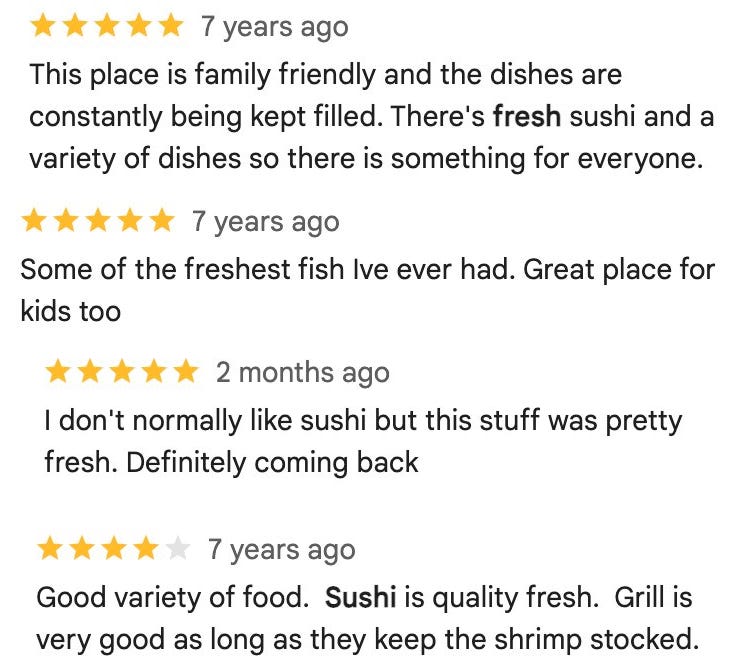
“Fresh” has long been a lexical pet peeve of mine: a word that sounds descriptive but is hard to pin down, and can therefore be applied with broad, sweeping, thoughtless strokes. When applied to sushi, “fresh” is an empty signifier—if sushi is good, it is therefore “fresh.” Plenty of other words fall into this pet peeve category (don’t get me started on “savory”), though there’s something that sets “fresh” apart from the rest. It’s completely false.
Realistically, the fish you’re eating at any sushi restaurant, no matter the price range, has likely been flash-frozen. The FDA Food Code requires most fish intended for raw consumption to be frozen to at least −4°F for parasite destruction, so little worms don’t do backflips in your tummy. Some fish, like certain tuna species, are naturally at lower risk of parasites—but since these fish are probably caught off the coast of Indonesia, they’re usually frozen anyway, because boats and planes can’t get to Kansas that fast. In practice, fish is often super-frozen to -76°F or colder, not just to kill parasites but to prevent ice crystals from forming in the muscle cells, which would otherwise turn your meal to mush. Surprise! Nothing is fresh.
I recognize that this is pedantry, and that when people call a piece of AYCE-buffet salmon "fresh," they're probably not thinking about the transoceanic supply chain. "Fresh" gestures at a clean flavor, a lack of fishiness, a general sense of the ocean. Even in this colloquial sense, though, we're still getting it wrong. By chalking these qualities up to "freshness," we obscure the actual processes that make sushi delicious. Time to get even more pedantic.
The ironic truth is that many fish are at their tastiest when they aren’t fresh—which is to say, when they’ve been aged. Just as a dry-aged steak develops a deeper, more complex flavor over time, a piece of tuna held under the right conditions undergoes its own transformation: enzymes break down adenosine triphosphate (ATP) into inosine monophosphate (IMP), one of the main compounds responsible for umami. The wonder of a good piece of tuna at a high-end sushi bar comes, in large part, from the fact that it isn’t fresh at all.
Aging isn’t the only thing that makes sushi so tasty. Plenty of factors determine whether a piece of fish sings: whether it’s in season, where it was sourced, the fish’s fat content, the chef’s knife skills, what part of the fish is being used. Some nigiri nerds like myself would happily claim that the preparation of the sushi rice is just as important as the fish itself, if not more so. Yet if we’re eating a piece of sushi and trying to decipher how fresh it is, we’re never going to notice any of these other attributes.
Thinking about sushi in terms of freshness flattens it. This is why I’m happy to get hot and bothered over the wording in a Yelp review. I love food writing because I believe words and food are inextricably connected: the phrasing we use to talk about the things we eat shapes our perception of them. Our threadbare vocabulary is stripping some of the pleasure from eating. That, to me, is an unforgivable sin.
My theory is that this is more of a cultural failing than a linguistic one. Compared to Japan, American food culture is a lot more squeamish about raw protein. (See: my old essay on eating raw chicken.) We have other words available to describe our fish, but we lean on "fresh" as a safety signal—more reassurance than praise, a way of telling ourselves this won't hurt me. You've probably seen fish in the grocery store labeled "sushi-grade" or "sashimi-grade." These are marketing terms that mean exactly nothing.
Framing cuisine through an outsider’s anxiety poses issues in its own right. I’d go so far as to argue that every time we praise sushi as fresh, we’re tacitly framing it as a foreign cuisine that needs to be rendered safe for us, rather than a tradition with its own standards. We’re unwittingly keeping sushi at an arm’s length. The good news is that we can do better.
We're capable of developing the language to more critically assess what we consume. A seasoned sommelier and a wine novice have the same taste buds, but the somm knows what to look for. They may experience the same intensity in a nice Malbec, but the sommelier knows to call it blackberry, plum, a hint of pepper—and in naming these notes, gets something more from the experience.
You don’t need to be a connoisseur to know good sushi from bad, but when you have the language to describe the buttery richness you love in a piece of high-quality yellowtail, you can find it, remember it, prefer it, seek it out. And when you find yourself in front of a piece of aji nigiri or a briny oyster, you’ll know you’re eating something with a flavor that degrades quickly; you can relish the rare chance to enjoy something that is well and truly fresh.