

Everyone's A Critic
Beli’s new taste economy. Also, arugula.

When Craig Claiborne became food editor at The New York Times in 1957, the average American had no idea what arugula was. The thought alone is enough to send a chill down my spine. Today, I can hardly imagine life without punchy, piquant arugula—rocket, for my English readers. What other bitter green would I use to top my pizzas? What other salad base would provide that peppery, nutty bite? Watercress? Mustard greens? Don’t be ridiculous.
Thank goodness for Claiborne: the father of American food journalism, who shaped the way we think about, write about, and eat about food. He was the first modern restaurant critic and a rare champion of international cuisine in an era when the only acceptable options were “French,” “Beige,” and “Jell-O”—or some combination of the three. Notably, he also introduced readers to the wonders of arugula, extolling its virtues in a 1960 piece that may contain my favorite headline of all time: “A Green by Any Name: Pungent Ingredient Is Cause of Confusion for City Shopper.”
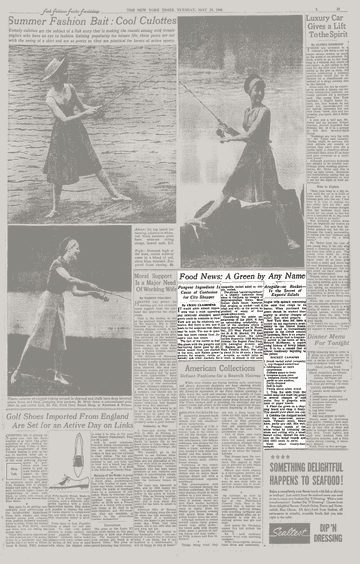
The whole article runs fewer than 500 words, but it introduced New Yorkers to a brand-new vegetable. Claiborne showed them that if they ventured into Manhattan’s Italian markets, they could expand their culinary horizons—that they might discover the “secret ingredient of [the] salads-about-town.” How can you read a sentence like this and not want to rush to the shops immediately? Never mind that he caps the piece with a canapé recipe that is “almost insidiously beguiling to the palate.” Truly, I could cry.
Claiborne’s arugula advocacy is far from the only time a food journalist has shaped the way we dine. Ruth Reichl changed the restaurant experience, showing that atmosphere could matter just as much as cuisine. Fuchsia Dunlop helped reshape the Western understanding of Chinese cuisine, revealing its regional depth and complexity. Jonathan Gold put a spotlight on immigrant neighborhoods and strip-mall joints—I can feel his impact nearly every time I eat out in Los Angeles. These are writers and critics who have entertained and educated us in equal measure, encouraging us all to be more curious and culturally aware. Hooray for the critics, I say!
Unfortunately, my zest (ha-ha) for food media isn’t reflected in the current landscape. People aren’t reading magazines or newspapers the way they used to. The industry is plagued by layoffs, and food writers are being banished to the far corners of the internet, forced to share their work on Substack blogs for audiences composed mostly of other food writers. Those who do keep their jobs are confined to content that is digestible, inoffensive, and smilingly uncynical. Lord have mercy, the sharp-minded food journalists of yesterday are now being forced at gunpoint to make TikToks.
If there is any glimmer of hope amid all this, it might be found on Beli. It’s a restaurant-review app where you can log and rank every dining establishment you visit—every last bar, coffee shop, pierogi house, and stroopwafel stand. And if you’ve spent any time around me, you know I don’t play about my Beli account. (If you dig back through the archives, you’ll see that I’ve written about it before on this Substack.) As of press time, I’m 116 weeks and 1,279 dining establishments into this bad boy, and I have no intention of slowing down.
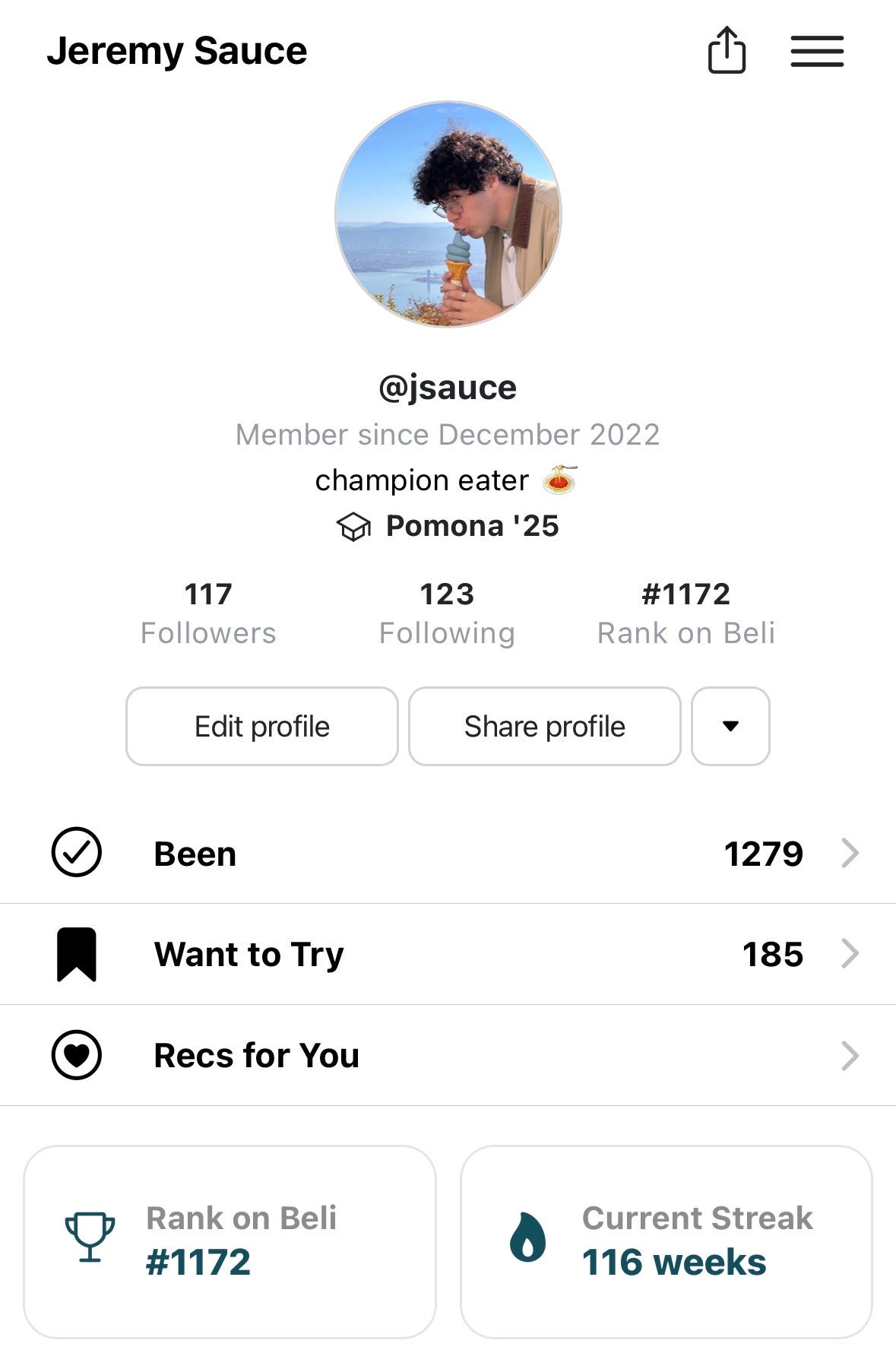
Whereas more established platforms like Yelp and Google Reviews focus primarily on the businesses themselves, Beli is very much a social media platform. It’s just as much about you as it is the places you’re reviewing. When I open the app, I’m not looking for anonymous reviews on a 1–5-star scale—I’m looking to tell everyone where I, Jeremy, had dinner. You can see a similar principle at work with Goodreads for books and Letterboxd for movies: here, you’re invited to step into the shoes of a critic and wax as poetic as you like. It’s clearly a model well suited to the digital age, as roughly 80 percent of Beli’s users are under 35. If nowhere else, on Beli, young people are excited about dining again.
So, to employ yet another gratuitous food metaphor, I eat this stuff right up. Though I’m not writing sprawling essays on Beli, I love having an archive of the places I’ve dined—a kind of digitized memory—and the process of ranking them against each other gives me a feeling of judicious civility. Like I’m a real restaurant critic, damn it.
This feeling is only intensified by the fact that my account has garnered a decent bit of attention. My culinary gallivants around Japan have perched me atop the Beli user leaderboard for the city of Kyoto two years running. As such, whenever a fellow user is looking for a Kyoto restaurant recommendation—perhaps while planning an epicurean vacation—the app naturally guides them to my profile. And every time someone follows me or bookmarks a spot from my list, I get a notification. It happens a couple of times a day, and each time the feeling it elicits in my brain is that of a hundred simultaneous orgasms.
I know these people aren’t following me because of my reviews. The one thing that matters on Beli is experience: I’ve eaten at nearly 200 restaurants in Kyoto, so I’ve tried more food there than most. I’d certainly like it if these people were poring over every word I write, but I’m nevertheless able to derive a great sense of self-importance from the whole thing. I’ve done the hard work of figuring out which spots are worth eating at, and now other people can reap the benefits. I am a steward of Kyoto, and I will do for this city what Craig Claiborne did for the humble arugula.
Hmm. Maybe this is all a bit much. It should be obvious to anyone with a functioning palate that there’s more to criticism than this—it’s not enough simply to have visited a lot of restaurants. My favorite food journalists are wordsmiths, and their articles and reviews often outlast the restaurants they’re written about. A real critic is discerning and thoughtful, culturally attuned, eloquent, and able to make a convincing argument. This app is a great bit of fun, but you could never confuse Beli users with actual critics. Right?
Recently, Beli rolled out a new subscription service. You can apply to “become a creator,” whereafter you can charge your most dedicated foodie followers a monthly fee to access your “custom guides.” You will notice that I am not yet eligible, as I haven’t referred enough people to the app. On a completely unrelated note, if you don’t currently have Beli and are thinking about downloading it, I would be happy to send you a referral link.

If I—a self-proclaimed Beli obsessive—am not qualified to monetize my platform, who is? To answer that question, I scoured the all-time Beli leaderboards, looking for diners even more devoted than I. That’s where I found Sue. She leaves me in the dust, having eaten at a whopping 5,000-plus restaurants and amassed an even more whopping 8,000-plus followers. And if you pay $3.99 a month ($29.99 for a year’s subscription), you can learn about what NYC restaurants have her “fav patio vibes.”
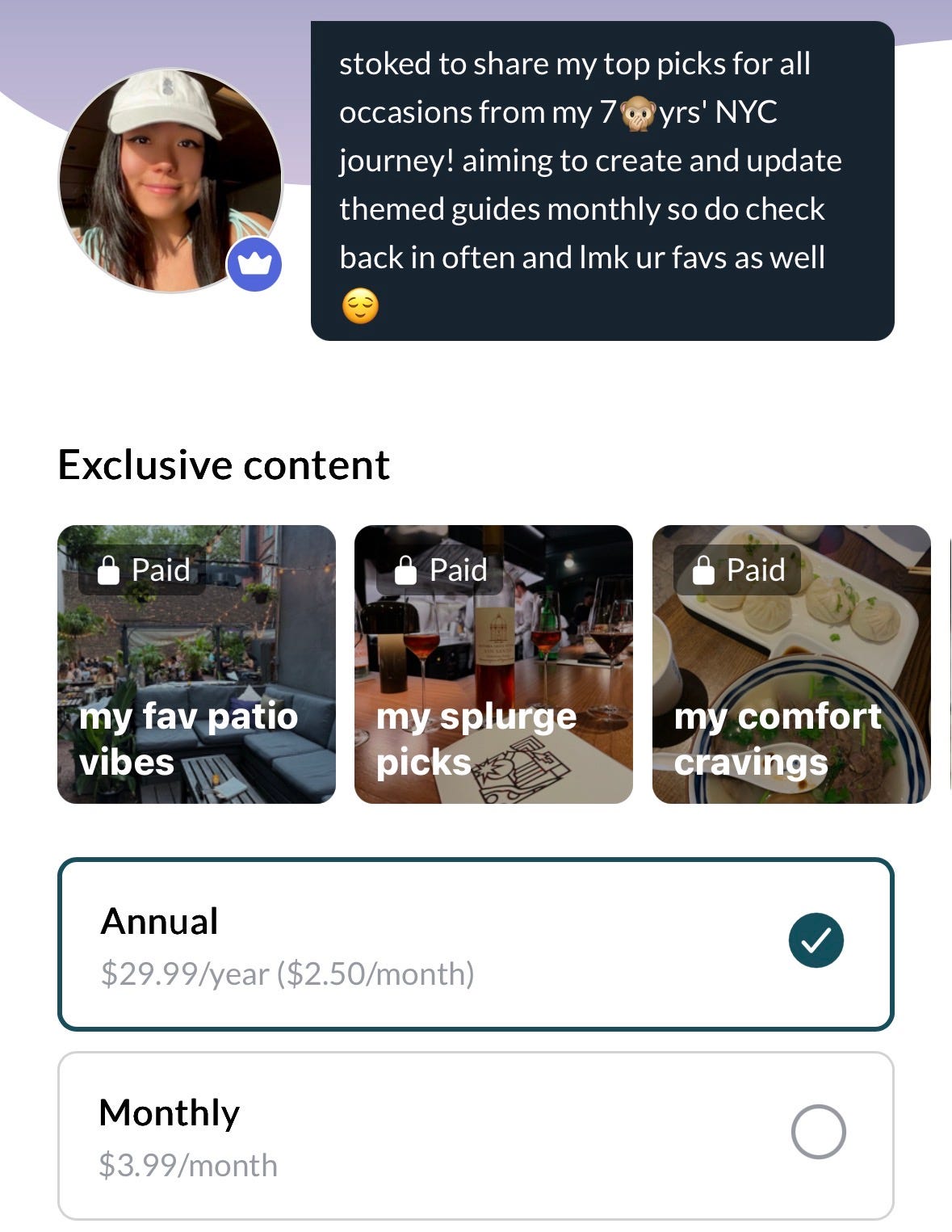
This presents me with a new question: why would anyone do that?
I’m sure Sue is a lovely person and has a very discerning palate, but her account is private, so I can’t read any of her reviews. As far as I can tell, her qualifications for giving advice are that she’s visited a lot of restaurants. Which is great—but are those qualifications worth paying for?
I don’t mean to single out this one user. There are plenty of other creators like her, most of whom seem to be regular people who happen to have a vast disposable income. And some of these creators write public reviews! I found one such user who has dined at the most luxurious fine-dining establishments in the world—places I would saw my own leg off for. You would think I’d at least trust his criticism, except that just about every review he writes is clearly the work of ChatGPT.
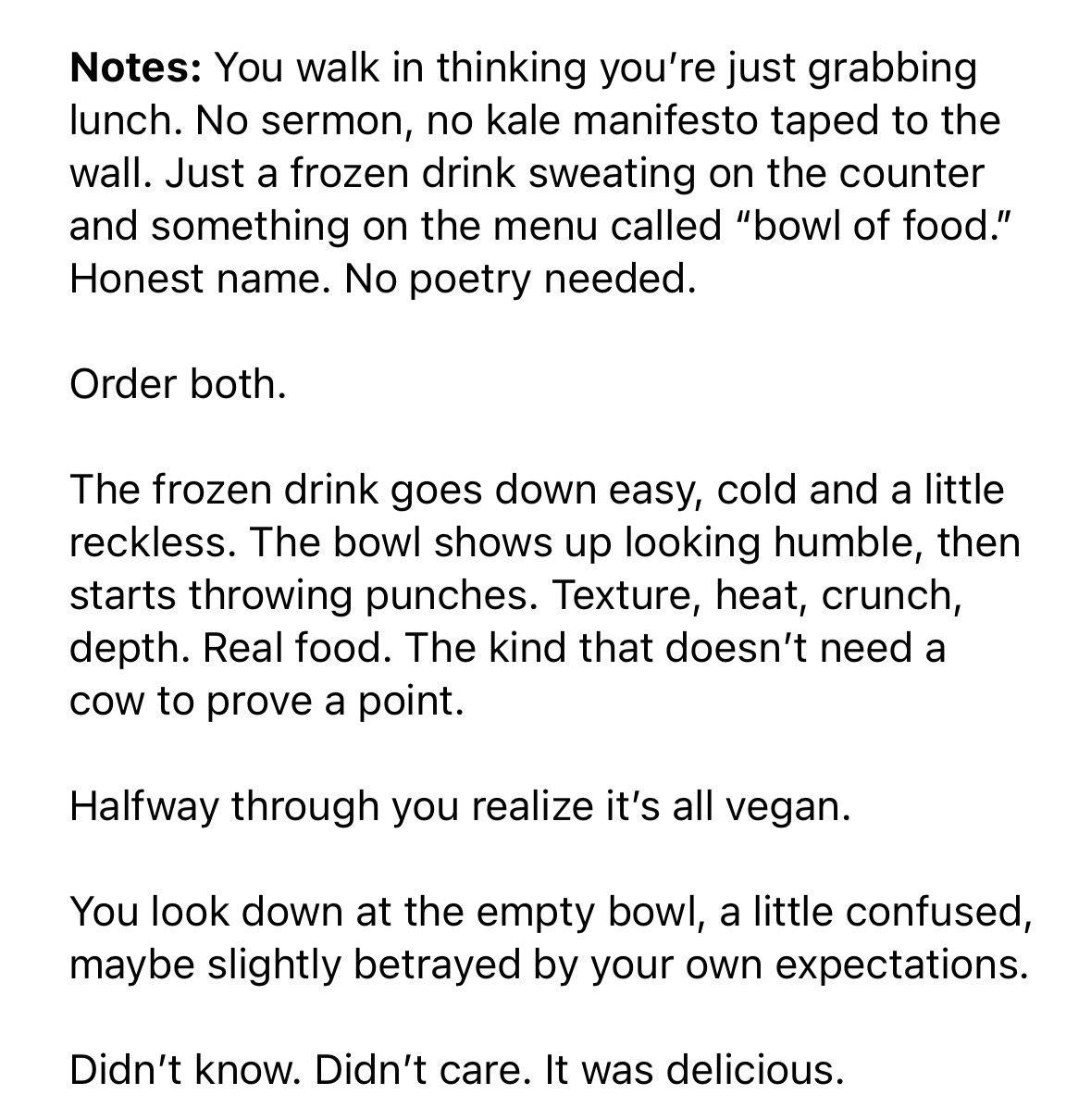
If Beli is our life raft out of the sinking ship of food journalism, this could be a sign that we’ve sprung yet another leak. I read a lot of food criticism, and I edit some food criticism, and I try to write a little food criticism. And while I appreciate that people are using Beli—thinking about restaurants and sharing their thoughts on them—I sometimes worry that these free-for-all, “everyone gets to have a take” platforms will come to be seen as a substitute for proper criticism, written by people with a different kind of experience. I think of this “proper criticism” as something far more considered, far more entertaining, and ultimately far more useful.
And if it seems like I’m bitter about these Beli creators and their paywalled parody of critique—perhaps even a little jealous—then let me reassure you that I am absolutely teeming with jealousy. I’ve been writing this nonsense for free! If I could convince people to pay me $4 a month to slap together a list of restaurants I’ve already been to, I would do so in a heartbeat. Unfortunately, as much as I love my 117 Beli followers (not to brag), the vast majority of them are friends of mine, who would, upon seeing me beg for money in the guise of a “best Orange County bánh mì” list, promptly call in a wellness check.
With all this said, I’m sympathetic to Beli’s strategy—and not just because I’m addicted to the app, and not just because Beli co-founder Eliot Frost is a fellow alum of Pomona College (chirp chirp, go Sagehens). The app has been ad-free since I downloaded it in 2022, and its user base has grown exponentially since then; I figured it was only a matter of time before they started trying to monetize. This approach feels a little clunky, perhaps a little naïve, and I have a feeling that most of these Beli creators aren’t earning the big bucks. But if the idea is that citizen critics can fill the vacuum left by professional ones, then I suppose I can get over myself. The life raft has sprung a leak, but it beats having to doggy paddle.
I wonder what Craig Claiborne would think about all this. Though his work at The New York Times laid the foundation for the careful, intellectual food journalism I hold so close to my heart, many of his early dispatches were nothing of the sort. A Pete Wells retrospective describes how Claiborne’s early contributions consisted of “four or five capsules a week of less than 100 words each, most of which concerned prices, addresses, and other data.”
Sounds like the kind of reviews people write on Beli. Food for thought?